Seven Detection Engines in the Agent You Already Deployed
EDR-class malware, behavioral, and integrity detection ships in the same binary as AI governance - no second install, no second console, no second invoice.
Two Agents, Two Blind Spots
The standard answer to AI risk is to add a tool: keep the EDR agent for malware, add an AI security product for the model layer. The result is two agents competing for the same endpoint, two consoles with different device lists, and a gap between them where AI-initiated threats live.
An AI agent that installs a vulnerable package, pulls down and runs an unvetted script, or modifies system startup is doing something both categories should catch and neither reliably attributes.
The Seven Engines
| Engine | Function | Method |
|---|---|---|
| AI Tool Discovery | Find every AI coding tool on every endpoint | Filesystem, network, behavioral, and deep telemetry layers |
| Secret Scanner | Detect credentials and sensitive data in AI conversations | 37+ patterns plus entropy analysis for secrets no pattern knows about |
| Native Malware Scanner | Detect malicious binaries and files | 6.5M+ malware signatures, refreshed automatically every four hours |
| YARA Scanner | Scan for malware signatures and suspicious binaries | Industry-standard YARA rules, built in with nothing extra to install |
| IOC Matcher | Match against curated threat intelligence | File, domain, and IP indicators from continuously updated threat feeds |
| Sigma Behavioral | Detect suspicious endpoint behavior | Behavioral rules with full MITRE ATT&CK mapping |
| File Integrity Monitor | Detect modification of critical system files | Tamper baselines with real-time change alerts |
Native malware scanning
Protection is on from the moment the agent enrolls - no setup step, no configuration. Signatures refresh automatically every four hours, downloads are scanned the moment they land, and scheduled quick scans plus on-demand full scans cover the rest of the disk.
The scanner is built to stay quiet: trusted software does not generate alerts, while files that just arrived from the internet get the closest scrutiny. Your team investigates real threats instead of triaging noise.
Behavioral coverage
Behavioral rules mapped to MITRE ATT&CK catch the techniques attackers actually use - malicious downloads, obfuscated commands, remote-access footholds, credential theft, and attempts to persist across reboots - whether the actor is a human or an AI agent.
Endpoint posture checks
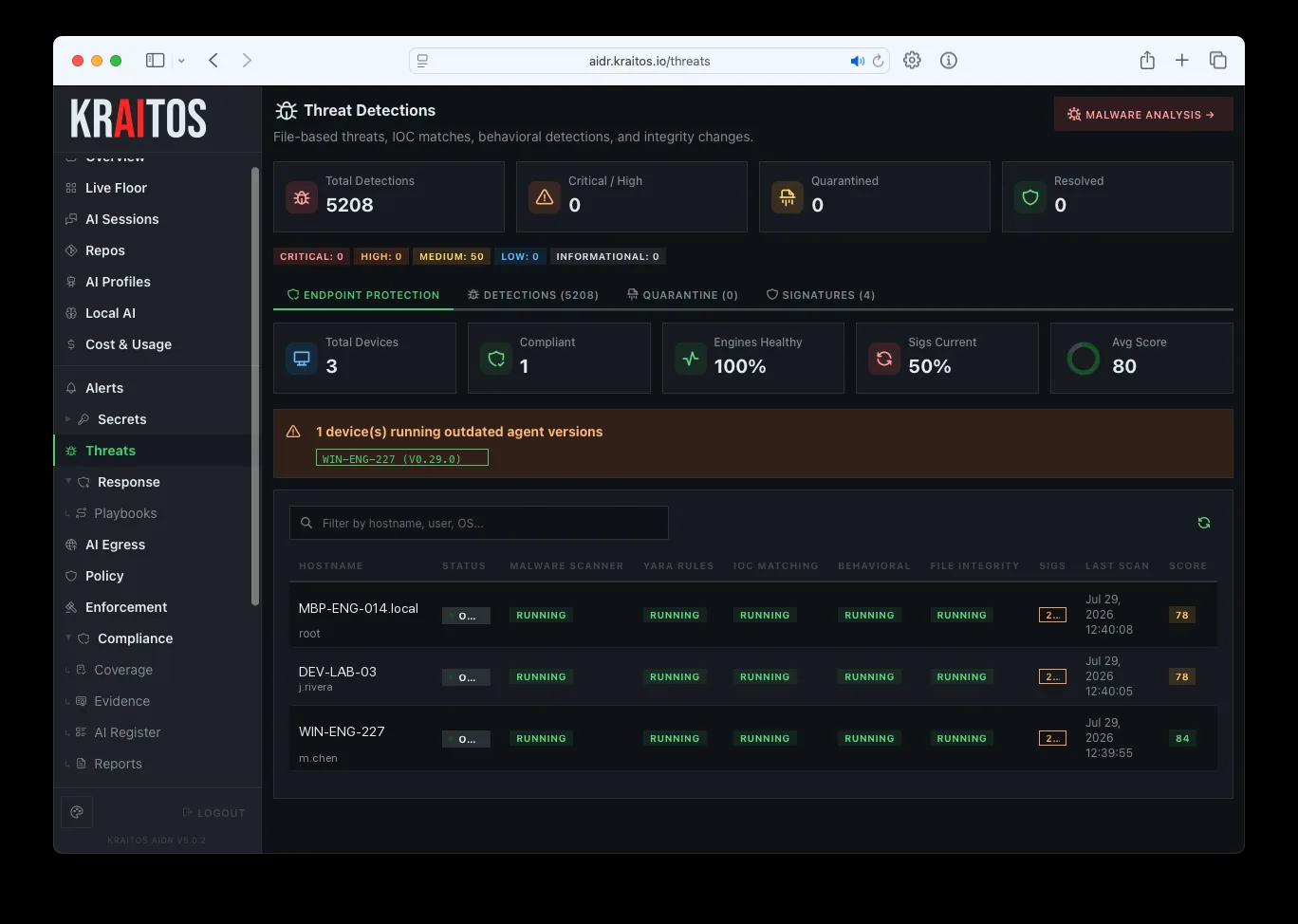
Verified continuously across the fleet, so you always know which machines meet the bar.
| Check | macOS | Windows | Linux |
|---|---|---|---|
| Disk encryption | FileVault | BitLocker | LUKS |
| Screen lock | Lock on wake | Screen lock policy | Desktop screen lock |
| Firewall | Application Firewall | Windows Firewall (all profiles) | ufw / firewalld / iptables |
Compliance scoring
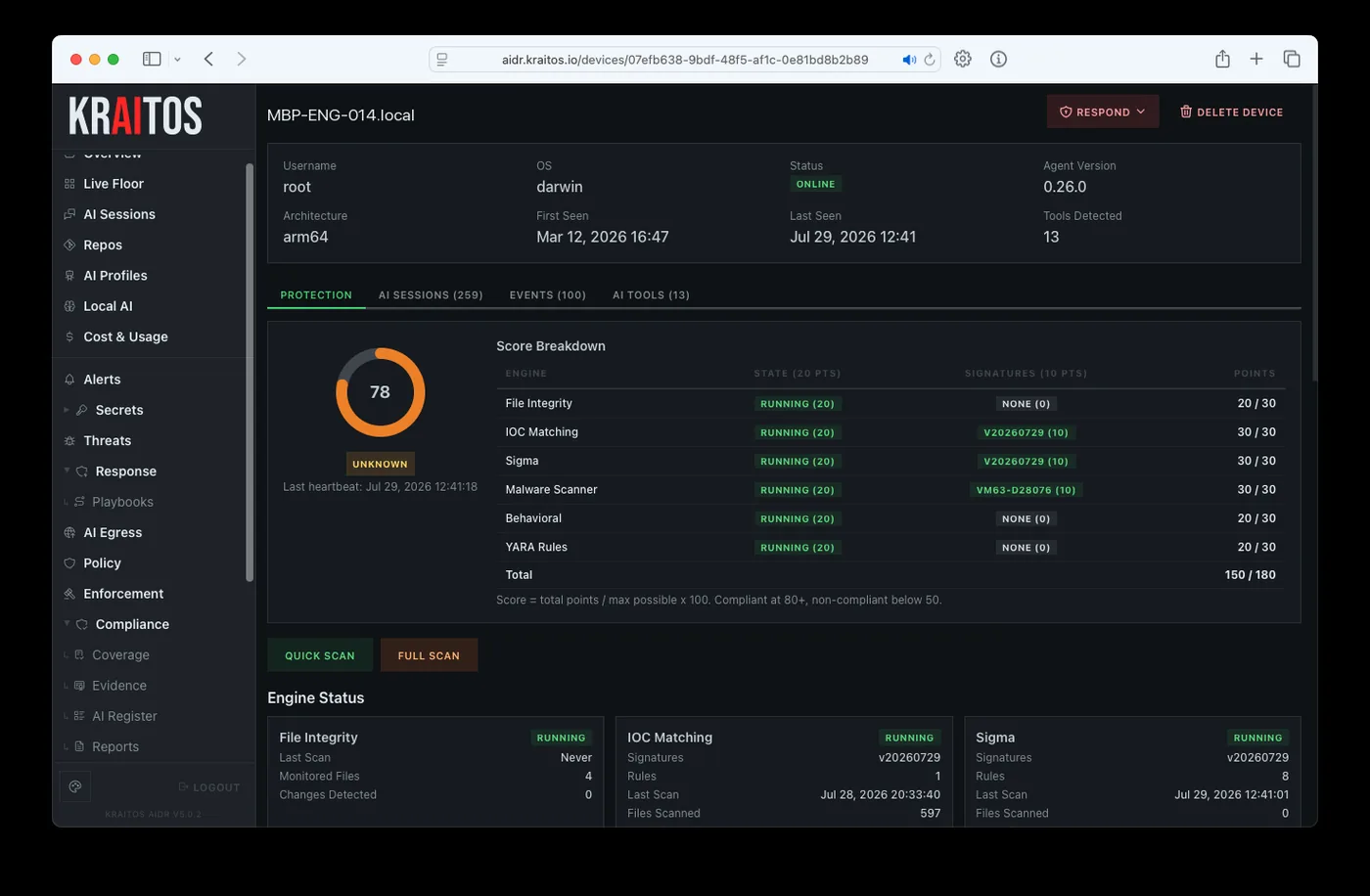
Every device carries a 0–100 score computed from engine health, signature freshness, and posture - one number that tells you whether a machine is protected.
- 80+ - compliant
- 50–79 - partial
- Below 50 - non-compliant
- Transparent breakdown - admins see per-engine point allocation and can tell exactly why two machines score differently
Device Health and Threat History
Controls This Evidences
- PCI 5.2
- Malicious software prevention - native scanner, YARA, IOC matching, quarantine
- NIST SI-3
- Malicious code protection across the fleet
- NIST SI-7
- Software, firmware, and information integrity - file integrity monitoring
- ISO A.8.9
- Configuration management - disk encryption, screen lock, and firewall posture
- HIPAA §164.312(a)(2)(iv)
- Encryption and decryption - disk encryption posture evidence
See Kraitos AIDR in Action
Deploy in 60 seconds. Get answers in 24 hours. Stop guessing what your AI-augmented organization is doing.
[email protected]kraitos.io