Write the Policy Once. Every Endpoint Enforces It Instantly.
Author policy in the dashboard, stream it to every agent in under a second, and evaluate it locally on the endpoint - with no latency cost to the developer.
Proxy-Based Enforcement Taxes Every Request
The common approach to AI policy is a cloud proxy: route every model call through a gateway and inspect it there. That adds a network hop to every request, creates a single point of failure for developer productivity, and stops working the moment a tool talks to a provider the proxy does not front.
Kraitos AIDR evaluates policy where the activity happens. Rules stream to the agent and are enforced locally in sub-millisecond time, whether the endpoint is on the corporate network, on a home connection, or offline.
Watch Quietly or Block Outright - Your Call
Monitor mode - see everything, interrupt nothing
| Rule | What it catches |
|---|---|
| Blocked tool use | Use of a tool that policy designates as blocked |
| Usage limits | A user exceeding token limits per day, week, or month |
| Sensitive file access | An AI agent reading a path flagged as sensitive |
| New tool detected | An unapproved AI tool appearing on an endpoint |
| Data volume anomalies | Unusual spikes in AI data transfer |
| Endpoint gone quiet | An endpoint that stopped reporting |
| Off-hours activity | AI activity outside defined business hours |
| Model restrictions | Use of an unapproved model |
| Sensitive data in prompts | Potential data-leakage patterns in prompts |
| Unapproved MCP servers | Connection to an unauthorized external tool server |
| Budget thresholds | Spend exceeding a budget threshold |
Enforce mode - stop it before it happens
| Rule | What it prevents |
|---|---|
| Block tool actions | Specific tool invocations, such as shell access for AI agents |
| Block MCP servers | Connections to unauthorized external tool servers |
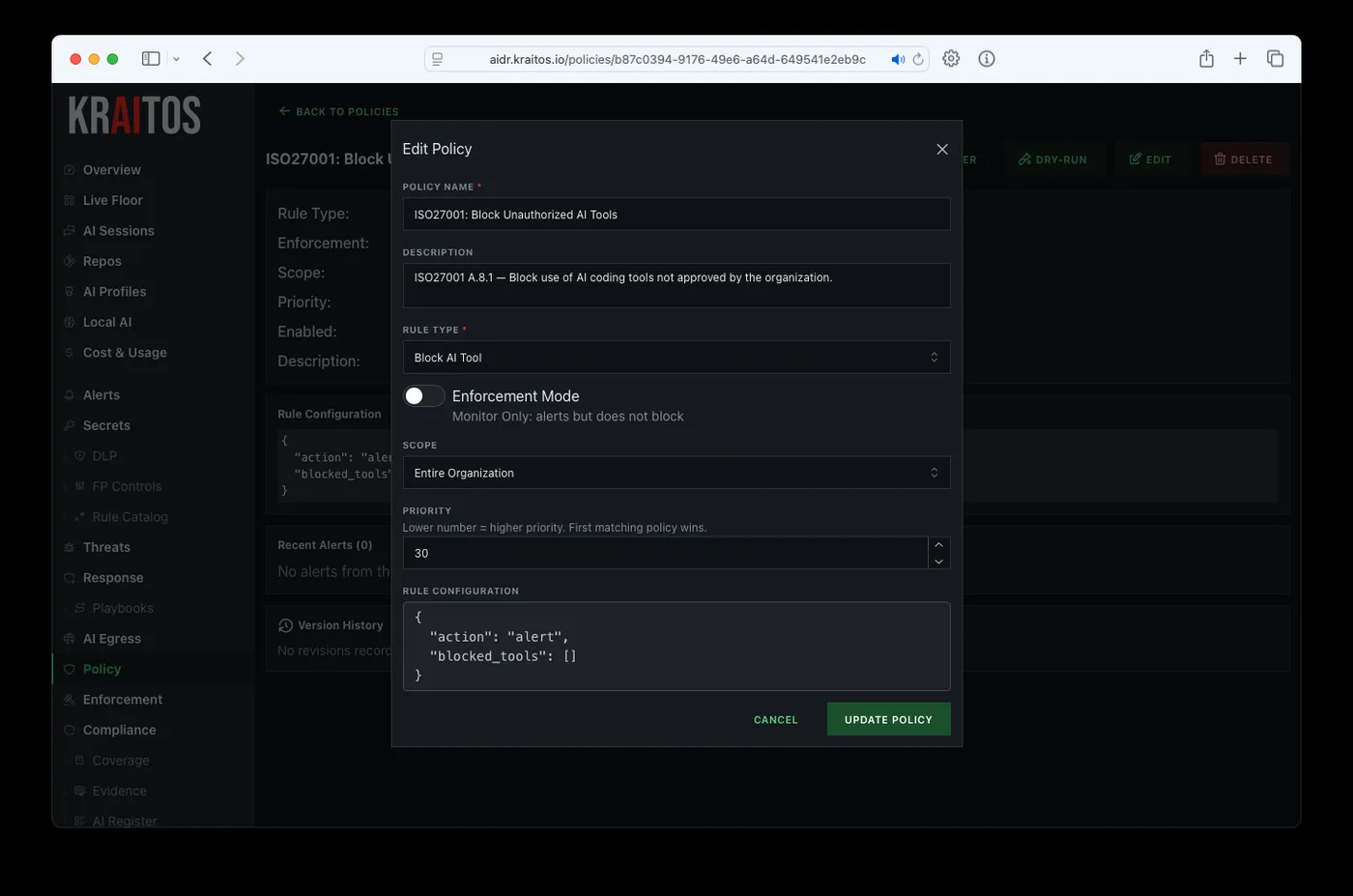
| Block an AI tool | A specific AI tool from running at all |
| Block shell commands | Specific shell commands from AI execution |
| Restrict file access | AI agents reading protected directories |
| Require approval | Gates an action behind a human approval workflow |
Dependency audit
| Rule | Effect |
|---|---|
| Vulnerable packages | Block installs of packages with known CVEs |
| Package audit | Log every package install performed by an AI agent |
Scoping and lifecycle
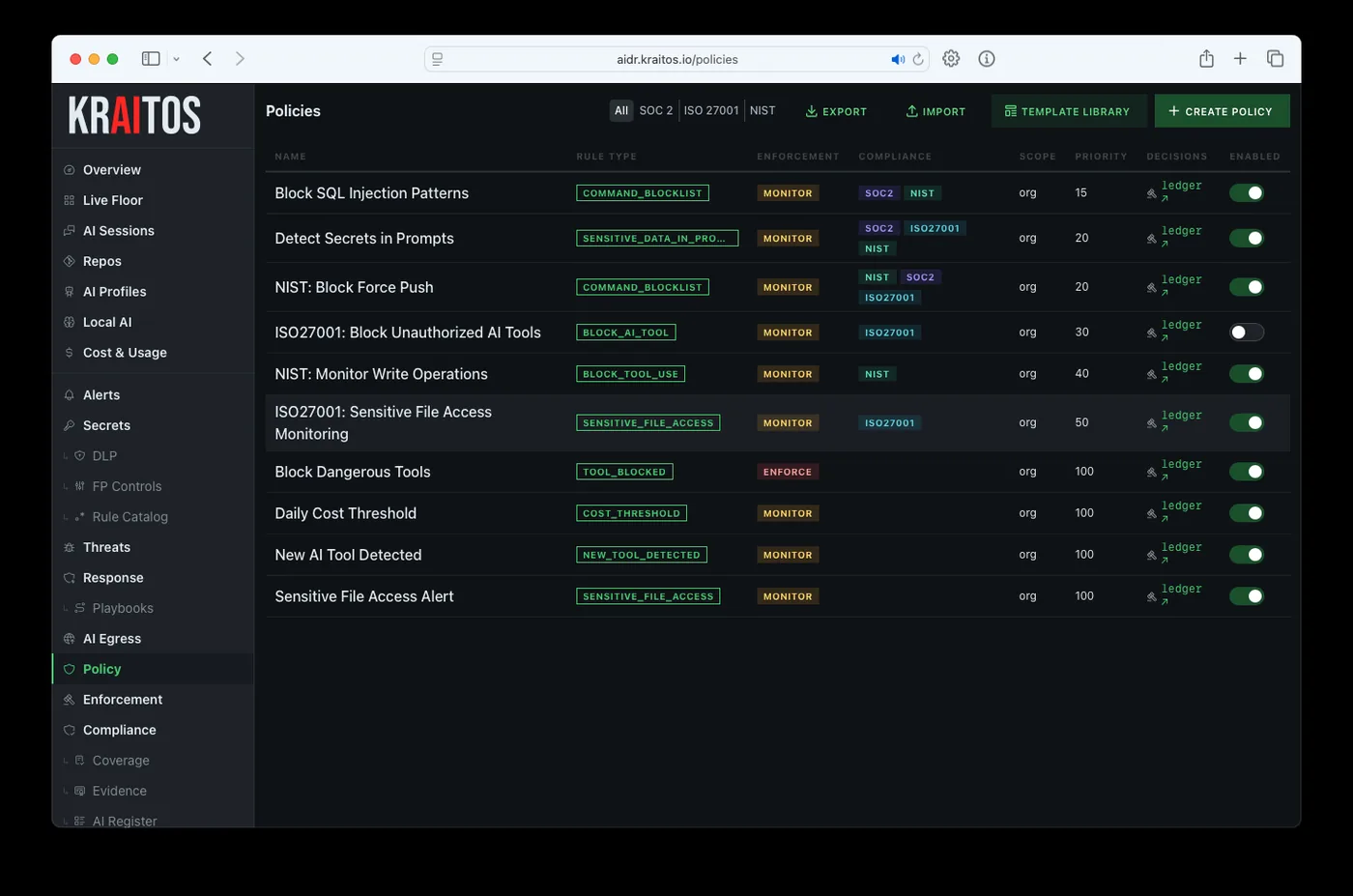
- Hierarchical scoping - policies scope to org, team, device, or user, and priority-based evaluation means the most specific applicable policy wins
- Versioned history - every policy change is recorded, and exceptions are first-class and audited
- Compliance templates - one-click policy sets for SOC 2, ISO 27001, NIST 800-53, HIPAA, and PCI-DSS, each mapped to specific controls
- Distribution - policy changes reach every agent in under one second
Policy Authoring and Enforcement Log
Controls This Evidences
- SOC 2 CC6.1
- Logical access controls - policy enforcement records and MCP allowlist enforcement
- NIST AC-6
- Least privilege - restricting what AI agents may execute and read
- NIST CM-5
- Access restrictions for change - command and package controls
- ISO A.8.22
- Segregation of networks and services by policy scope
See Kraitos AIDR in Action
Deploy in 60 seconds. Get answers in 24 hours. Stop guessing what your AI-augmented organization is doing.
[email protected]kraitos.io