Real-Time DLP for AI Conversations - Detect, Redact, Allow
37+ detection patterns across five data categories scan AI conversations as they happen, with redaction that removes the secret and keeps the developer working.
Credentials Live Where AI Agents Read
AI coding agents encounter credentials constantly - API keys in config files, database passwords in environment variables, private keys in deployment scripts. The agent does not know which strings are sensitive; it reads what it is pointed at.
Without protection those secrets end up in prompts sent to cloud LLM providers. Depending on the data class, that is a credential exposure event, a PCI scope problem, or a notifiable breach.
Detect, Attribute, Verify, Rotate
Five data categories
Each category carries a derived compliance framework hint, so a finding lands in the right regulatory bucket automatically.
| Category | Framework hint | Examples |
|---|---|---|
| secret | — | API keys, tokens, private keys, connection strings |
| pii | GDPR | SSNs, email addresses, phone numbers |
| phi | HIPAA | Medical record number patterns |
| financial | PCI-DSS | Bank and account identifiers |
| pci | PCI-DSS | Primary account numbers (credit cards) |
Pattern coverage
| Group | Coverage |
|---|---|
| Cloud providers | AWS access keys and secret keys, GCP service account keys, Azure client secrets |
| Source control | GitHub PATs and fine-grained tokens, GitLab tokens |
| AI providers | OpenAI, Anthropic, and other LLM provider API keys |
| Payments | Stripe live, secret, and publishable keys |
| Communication | Slack bot tokens, webhook URLs, OAuth tokens |
| Messaging | SendGrid keys, Twilio auth tokens |
| Infrastructure | Private keys (RSA, EC, DSA, Ed25519), JWTs, database connection strings, Redis URIs |
| Regulated data | Credit card numbers, SSNs, emails, phone numbers, medical record patterns |
| Generic | Entropy analysis catches high-randomness secrets that match no known format |
Beyond detection - the full credential lifecycle
- Context-aware attribution - every finding records whether the secret appeared in a user prompt, an assistant response, or a tool call output
- Confidence scoring - computed from rule precision, entropy, source role, and verification state
- Live credential verification - supported types are probed against the provider and marked live, revoked, unknown, or unsupported
- Rotation workflow - from requested through rotating to confirmed dead, with a re-verification step that proves the leaked credential can no longer be used
- Redact-and-allow - surgically removes the secret from session data while preserving conversation context
- Rule catalog - built-in catalog plus your own custom rules, versioned and validated before distribution
- Allowlisting - per-tenant suppression for known-safe values, so test fixtures stop generating noise
Findings with Enough Context to Act
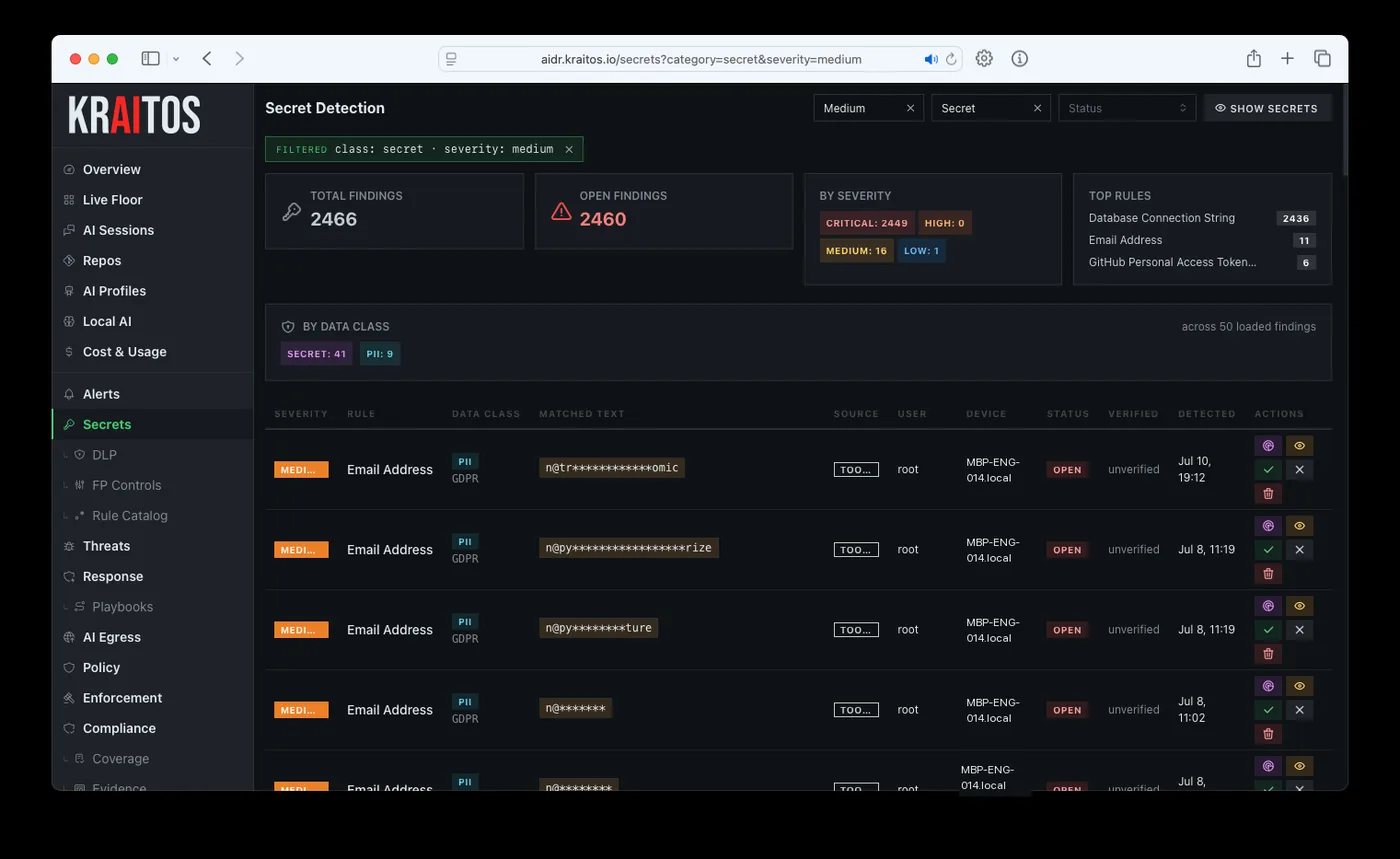
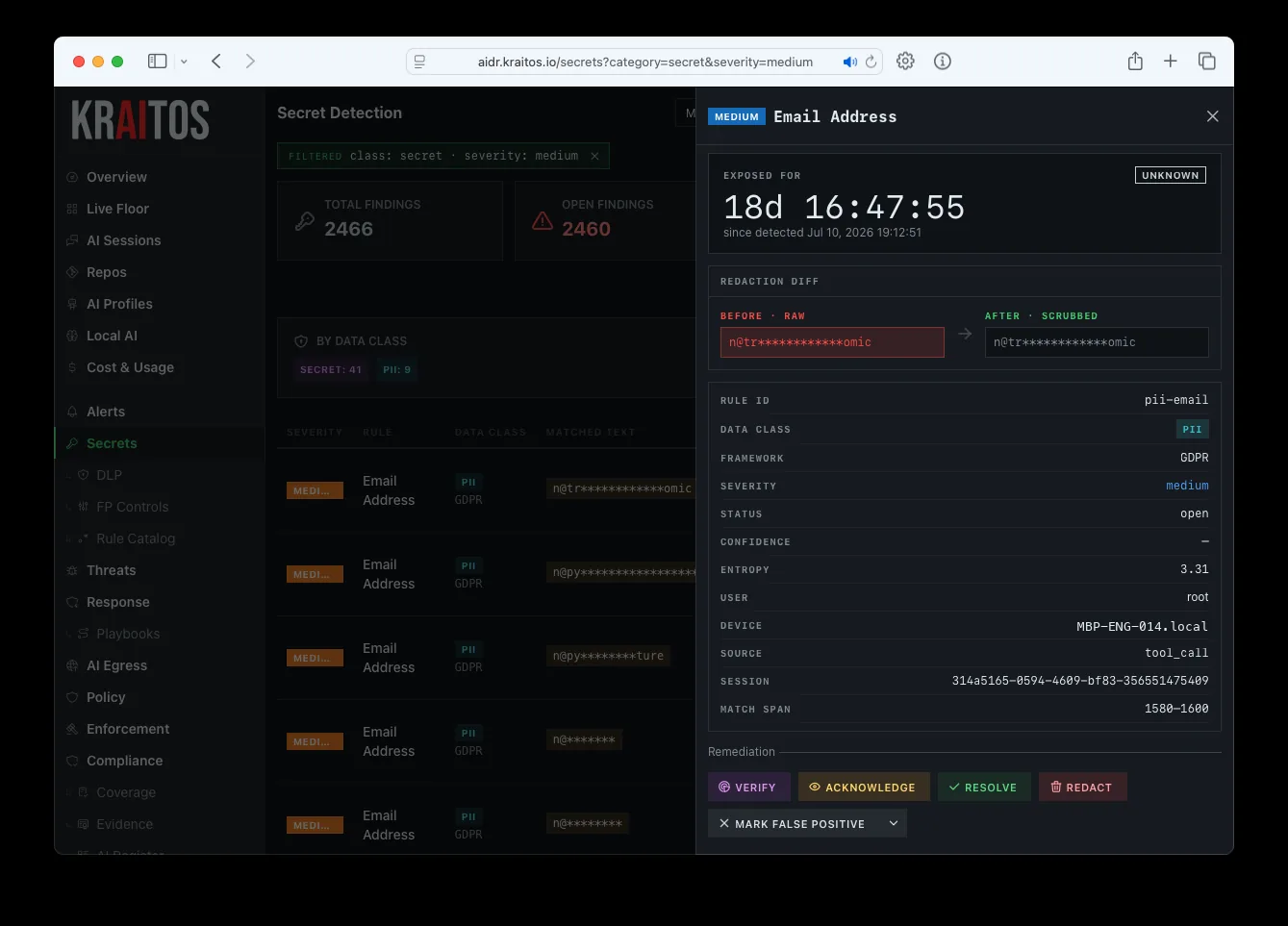
Finding Lifecycle
| Stage | States |
|---|---|
| Verification | Live · revoked · unknown · unsupported |
| Rotation | Requested → rotating → confirming → confirmed dead |
| Redaction | Pending → redacted |
| Resolution | Acknowledge · resolve · false positive |
| Analytics | Per-user and per-rule breakdowns with 30-day trends |
Controls This Evidences
- SOC 2 CC6.7
- Restricting the transmission of sensitive information
- ISO A.8.12
- Data leakage prevention across AI conversation channels
- PCI 3.4.1
- Primary account number rendering and exposure control
- HIPAA §164.312(e)(1)
- Transmission security for electronic protected health information
See Kraitos AIDR in Action
Deploy in 60 seconds. Get answers in 24 hours. Stop guessing what your AI-augmented organization is doing.
[email protected]kraitos.io